
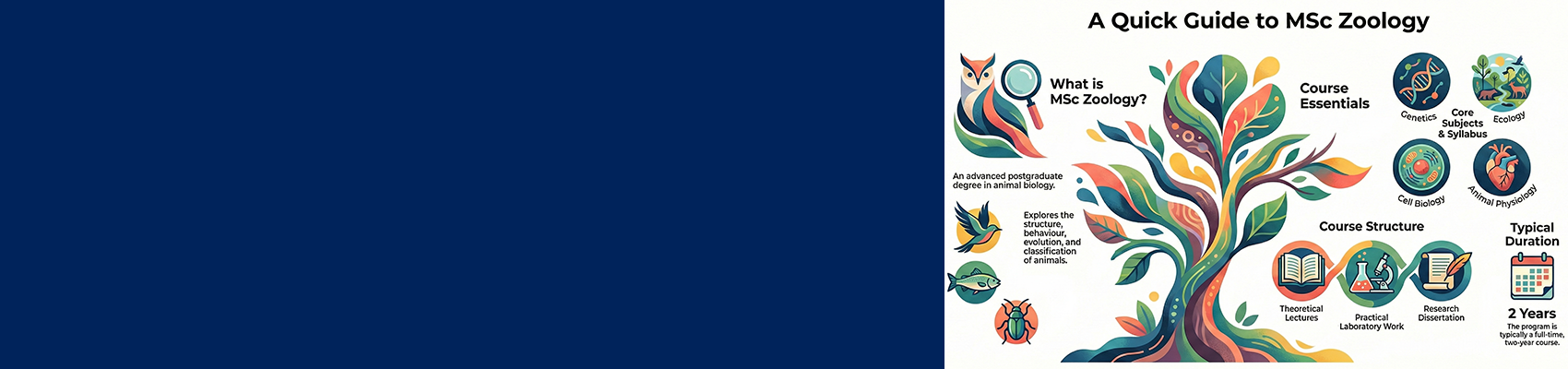
What exactly is M.Sc. Zoology as an academic and research discipline?
At the postgraduate level, zoology moves far beyond classification or basic anatomy. What is M.Sc. Zoology course is best answered by looking at how it trains students to think scientifically.
M.Sc. Zoology develops the ability to:
- Analyse animal systems at cellular, organismal, and ecological levels
- Understand evolutionary processes and adaptation
- Apply experimental methods to biological questions
- Interpret data in ecological, physiological, and behavioural contexts
In research terms, zoology acts as a bridge discipline—linking molecular biology with environmental and applied sciences.
How does zoology research align with current scientific priorities?
Modern biological research prioritises systems thinking. Whether studying ecosystems, disease transmission, or environmental impact, researchers must understand how living systems interact, not just isolated components.
Zoology contributes directly to:
- Ecology and conservation biology
- Animal physiology and adaptation studies
- Environmental impact assessment
- Fisheries and aquatic science research
- Wildlife biology and management
This systemic relevance explains why questions around what to do after M.Sc. Zoology increasingly points toward interdisciplinary research and applied science roles.
💡 Takeaway: Zoology prepares researchers to study life as connected systems, not isolated units.
What is typically studied in an M.Sc. Zoology syllabus?
The M.Sc. Zoology syllabus is designed to balance depth with breadth. While exact structures vary, the emphasis remains on building strong biological foundations alongside research capability.
Rather than memorisation, the focus is on conceptual clarity, analytical thinking, and scientific reasoning—skills that carry across research environments.
If you’d like a bit more clarity at this point, you can connect with us.
Speak with UsWhy learning format matters in biological sciences today
Biological research increasingly relies on digital tools, data analysis, and remote collaboration. In this context, M.Sc. Zoology Distance Education has gained relevance—not as a substitute for rigour, but as a structured way to combine academic learning with field exposure, laboratory observation, or professional engagement.
Distance education in zoology typically emphasises:
- Strong theoretical grounding
- Guided research orientation
- Field or project-based learning components
- Independent scientific reading and analysis
This format supports learners who are already engaged in education, fieldwork, or allied life science roles.
Who is zoology postgraduate education designed for?
Zoology at the postgraduate level attracts learners from diverse life science backgrounds. The discipline values biological continuity, not narrow entry points.
💡 Takeaway: Zoology builds on biological curiosity, not rigid academic labels.
What’s Next after this Program?
The question after M.Sc. in Zoology what can I do reflects a genuine concern about direction. In reality, zoology opens multiple-layered pathways, depending on how graduates apply their training.
M.Sc. Zoology Career options often extend into:
- Research and laboratory-based roles
- Environmental and wildlife organisations
- Fisheries, aquaculture, and marine sciences
- Conservation and biodiversity projects
- Academic and teaching pathways
- Interdisciplinary life science roles
Rather than leading to a single job identity, zoology supports research progression, applied science roles, and long-term academic development.
How zoology shapes scientific identity over time
Perhaps the most overlooked aspect of zoology education is identity formation. Zoology does not train technicians—it trains biological thinkers.
Over time, graduates develop:
- Comfort with complexity
- Respect for ecological balance
- Strong observation and analysis skills
- Ethical awareness in biological research
These qualities matter deeply in modern science, where biological decisions influence ecosystems, public health, and sustainability.
💡 Takeaway: Zoology shapes how scientists see life—not just how they study it.
Conclusion
In the context of modern biological research, M.Sc. Zoology represents far more than a subject specialisation. It is a way of understanding life through structure, function, interaction, and evolution. By combining theoretical depth with research orientation and applied relevance, zoology prepares graduates to engage with some of the most pressing scientific and environmental challenges of our time. Whether pursued through regular or distance education, the discipline builds scientific judgement, systems thinking, and long-term research capability—qualities that continue to matter as biology becomes increasingly complex, interdisciplinary, and socially consequential.
Frequently Asked Questions
M.Sc. in Zoology is a postgraduate program focused on advanced study of animal biology, integrating theory, research methods, and applied biological sciences.
The syllabus generally includes animal physiology, genetics, ecology, evolution, cell biology, biostatistics, environmental biology, and research methodology, supported by practical and project work.
The standard duration of the program is two years.
For Acharya Nagarjuna University Course Admissions , the candidate should hold a B.Sc. in Zoology, Fishery Science, Aquaculture, Industrial Fish and Fisheries, or a B.Sc. in Life Sciences or Environmental Sciences.
Graduates can pursue research, teaching, conservation work, environmental science roles, fisheries and aquaculture careers, or further doctoral studies.
