
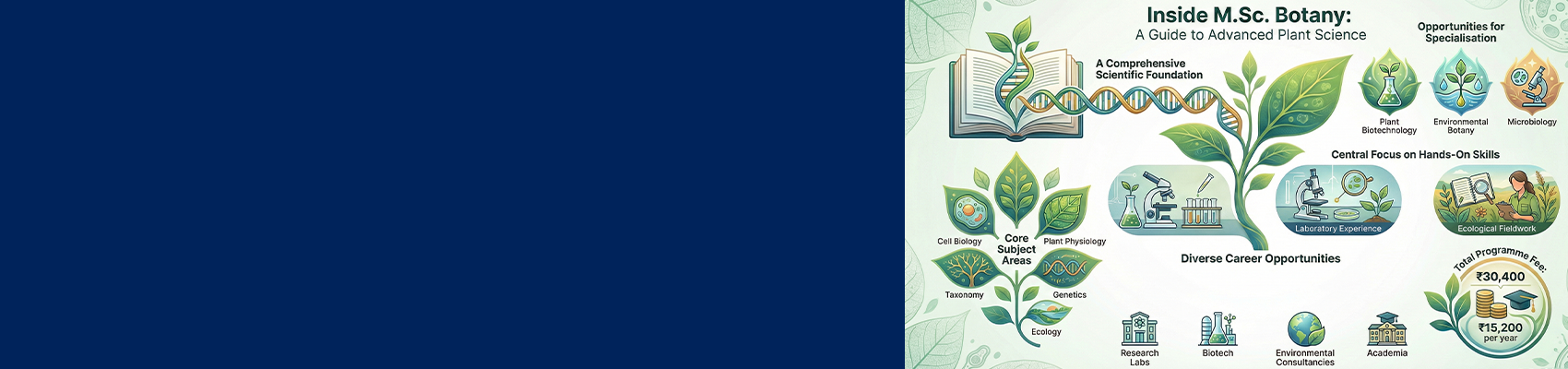
Scope of M.Sc. Botany Studies
The scope of this program is extensive because botany sits at the intersection of life sciences, environmental studies, and applied biological research. It explores how plant systems sustain ecosystems, support agriculture, and contribute to human health and climate stability.
Students gain both theoretical understanding and practical exposure to plant structure, growth, reproduction, and biochemical functions, preparing them for diverse scientific and industry-oriented roles.
Key academic domains covered under the M.Sc. Botany Core Areas include:
- Cell Biology and Genetics
Focuses on cellular organisation, cell division, gene expression, and inheritance patterns. Students learn how genetic mechanisms regulate plant development, variation, and adaptation at the molecular level. - Plant Anatomy and Morphology
Examines internal and external plant structures, helping learners understand tissue organisation, vascular systems, and structural adaptations that support survival and productivity. - Taxonomy and Systematics
Develops skills in plant identification, classification, and nomenclature. This area also introduces evolutionary relationships and biodiversity documentation, essential for conservation and ecological studies. - Plant Physiology and Biochemistry
Covers photosynthesis, respiration, transpiration, mineral nutrition, and metabolic pathways. Students analyse how biochemical processes drive plant growth and response to environmental stress. - Ecology and Environmental Botany
Explores plant–environment interactions, population dynamics, ecosystems, and climate-related adaptations. This knowledge is crucial for environmental management and sustainability research. - Palaeobotany and Evolutionary Studies
Investigates fossil plants and evolutionary history, offering insights into plant origin, diversification, and long-term ecological change. - Plant Pathology and Microbial Interactions
Focuses on plant diseases, host–pathogen relationships, and disease management strategies relevant to agriculture and food security. - Biostatistics and Research Methodology
Trains students in data analysis, experimental design, and scientific interpretation, enabling accurate evaluation of biological research findings.
Together, these core areas create a strong academic foundation that balances classical botany with modern scientific approaches. By integrating laboratory techniques, analytical skills, and ecological understanding, the programme equips learners for careers in research, agriculture, environmental science, biotechnology, and allied life science industries.
Practical Exposure, Hands-On Learning & Research Orientation
Practical learning is central to a postgraduate botany curriculum. M.Sc. Botany Practical Work involves microscopic examination of plant tissues, anatomical dissections, morphological studies, preparation of slides, and analysis of spores, pollen, and microorganisms. Students also conduct physiological experiments such as measuring photosynthesis rates, transpiration, enzyme activity, and pigment extraction.
These hands-on sessions train learners in designing experiments, recording observations, analysing results, and maintaining scientific laboratory discipline.
M.Sc. Botany Laboratory Training
Through M.Sc. Botany Laboratory Training, students gain experience in
using instruments such as spectrophotometers, microtomes, centrifuges, laminar flow
chambers, chromatography units, and PCR tools, depending on the curriculum. They learn
laboratory ethics, specimen preservation techniques, sample preparation, serial
dilutions, sterilisation methods, and environmental monitoring. The training develops
technical accuracy, which is essential for careers in research laboratories, biotech
companies, seed industries, and plant-based pharmaceutical organisations.
M.Sc. Botany Fieldwork
Field study is essential for understanding natural ecosystems. M.Sc. Botany
Fieldwork includes plant identification, herbarium preparation, ecological
surveys, population studies, soil analysis, and biodiversity documentation. Students
visit forests, agricultural fields, botanical gardens, wetlands, and research centres
to observe plants in their natural environment. These experiences teach learners how
plants adapt to climate, interact with soil microbes, respond to stress, and function
within ecosystems. Field exposure deepens scientific curiosity and builds practical
skills in ecological assessment and conservation.
Advanced Study Areas, Research & Innovation in Botany
A postgraduate program like M.Sc. Botany offers an advanced understanding of plant biology, blending classical botanical study with modern biotechnological research. Learners study molecular pathways, plant genetics, plant hormones, metabolic processes, and biochemical interactions at a deeper level. This prepares them for careers that require accuracy, analytical reasoning, and strong scientific methodology.
Students can explore M.Sc. Botany Specialisations such as:
- Molecular Biology
- Microbiology
- Environmental Botany
- Ethnobotany
- Plant Biotechnology
- Taxonomy
Each specialisation opens a niche area of scientific exploration—whether it's studying medicinal plants, understanding plant diseases, developing tissue culture techniques, or analysing climate impact on plant growth. Specialisations also help students target specific industries or research areas based on their interests.
The M.Sc. Botany Research Areas include:
- Plant tissue culture
- Genetic engineering
- Phytochemistry
- Molecular taxonomy
- Plant pathology
- Algal biotechnology
- Conservation biology
Students learn how to design experiments, collect data, analyse results, and present scientific findings. Research exposure improves problem-solving skills, scientific writing, and the ability to investigate plant-based innovations.
If you need personalised guidance, connect with our team now!
Speak with UsThe Program Overview
The program offered through Acharya Nagarjuna University supports learners with a structured academic framework, research exposure, and access to plant science learning resources.
The M.Sc. Botany learning outcomes include:
- Advanced knowledge of plant systems
- Scientific reasoning
- Laboratory accuracy
- Research methodology
- Ecological understanding
- Analytical skills
- Ability to interpret scientific data
Students learn how to apply theory in laboratory and field environments, preparing them for professional roles in teaching, research, environmental analysis, and biotech industries.
The M.Sc. Botany fee structure follows a simple yearly payment format:
- First year fee: ₹15,200
- Second year fee: ₹15,200
- Total programme fee: ₹30,400
Students pay the amount year by year, making the structure easy to understand and plan for.
Thinking after M.Sc. Botany, what can I do? Graduates can pursue careers in:
- Research laboratories
- Pharmaceutical companies
- Agricultural development agencies
- Environmental consultancies
- Seed and biotech industries
- Forestry departments
- Academic institutions
The degree also provides a pathway to doctoral studies for students interested in research and teaching roles.
Understanding the Syllabus
The M.Sc. Botany syllabus is designed to give students both conceptual depth and practical scientific exposure. It combines core plant science theory with hands-on laboratory work, field observations, and research-based learning. The course covers cellular processes, plant structure, physiology, evolution, biodiversity, genetics, ecology, and biotechnology. This combination ensures that students understand how plants function at the microscopic, organismal, and ecological levels.
Below are the major components of a typical M.Sc. Botany syllabus:
- Cell & Molecular Biology
This subject explores the structure and function of plant cells, cell division, DNA replication, gene expression, and molecular mechanisms that drive plant growth and development. Students learn how molecular processes control plant physiology and genetic traits. - Plant Physiology
Plant Physiology focuses on how plants carry out essential functions such as photosynthesis, respiration, nutrient absorption, water transport, hormone regulation, and stress responses. It helps students understand how plants adapt and survive under changing conditions. - Taxonomy & Systematics
This area teaches classification, naming, and identification of plants. Students study evolutionary relationships, plant diversity, herbarium techniques, and diagnostic features used to classify plant species accurately. - Genetics & Plant Breeding
Students learn the principles of heredity, genetic variation, and breeding techniques used to develop improved plant varieties. The subject covers Mendelian genetics, molecular markers, hybridisation, mutation breeding, and crop improvement strategies. - Mycology & Microbiology
This subject introduces fungi, bacteria, algae, and viruses, focusing on their structure, physiology, ecological roles, and interactions with plants. Students also learn about plant diseases and microbial applications in biotechnology and agriculture. - Ecology & Conservation Biology
Here, learners study ecosystems, biodiversity patterns, population dynamics, environmental interactions, and conservation strategies. It prepares students to understand ecological balance and contribute to environmental protection and sustainable resource management. - Plant Biotechnology & Tissue Culture
This subject covers modern laboratory techniques used in research and industry, including genetic engineering, tissue culture, micropropagation, and molecular tools. Students learn how biotechnology can improve plant growth, disease resistance, and crop productivity. - Phytochemistry & Metabolism
Phytochemistry examines chemical compounds produced by plants, including medicinal metabolites, pigments, and defence chemicals. Students explore metabolic pathways and the biochemical processes that regulate plant life functions.
This integrated syllabus combines theory, experimentation, and field-based learning to build scientific reasoning, technical accuracy, and research capability. By the end of the programme, students gain a strong understanding of plant systems and the skills required to work in laboratories, environmental organisations, agriculture-based industries, or research institutions.
Conclusion
An M.Sc. Botany programme offers far more than a deeper understanding of plants—it builds scientific thinking, observational accuracy, and analytical skills that prepare learners for both research and application-driven careers. Through theory, laboratory training, fieldwork, and exposure to modern biotechnological tools, students learn how plant systems function and why they matter in agriculture, medicine, conservation, and environmental sustainability.
With a curriculum that blends cellular biology, physiology, taxonomy, ecology, and molecular research, the programme equips learners to understand the plant world at every level—from microscopic structures to large ecosystems. Whether a student's goal is to work in research laboratories, pursue doctoral studies, join agricultural or biotech industries, or contribute to conservation and environmental management, the M.Sc. Botany provides the academic grounding and practical skills needed to move forward with confidence.
Frequently Asked Questions
M.Sc. Botany is a postgraduate degree focused on plant science, covering plant structure, physiology, genetics, ecology, biotechnology, and environmental biology.
Core subjects include molecular biology, plant physiology, taxonomy, genetics, anatomy, ecology, microbiology, biochemistry, and biotechnology.
The best field depends on your interest — options include plant biotechnology, environmental botany, microbiology, plant genetics, phytochemistry, or conservation biology.
A specialisation is an advanced focus area within the program, allowing students to concentrate on a specific branch such as genetics, plant biotechnology, ecology, or microbiology.
Botany focuses on the scientific study of plants — their structure, growth, reproduction, evolution, ecological role, and molecular behaviour.
